
🎾 Tennis Got Longer. Players Didn’t Get More Time.
Why Emotional Recovery and Emotional Strength & Conditioning are the missing links in modern performance
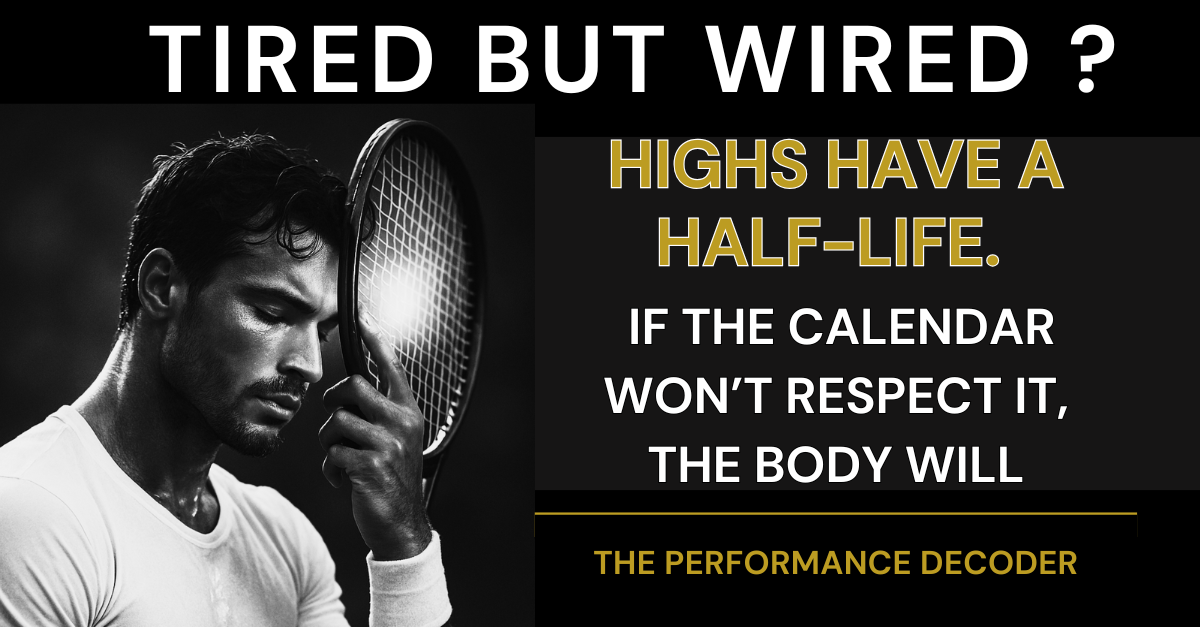
TIRED BUT WIRED Highs have a half-life. If the calendar won’t respect it, the body will.
1️⃣ The Moment
Last week, Jack Draper voiced what many players have been living silently: Twelve-day Masters events, endless travel, and “off-days” that aren’t off at all. He spoke of burnout and loneliness — the human cost of being constantly “on.”
That conversation is exactly why I wrote The Sixth Sense: Emotion. Because this isn’t just about scheduling. It’s about what happens when emotion never gets the chance to land.
2️⃣ The Hidden Cost of “Staying On”
Players are fitter, stronger, and better supported than ever — yet emotional volatility, anxiety, and injury rates are rising. Why? Because the nervous system has no scheduled recovery.
Each match, flight, and adrenaline surge adds allostatic load — the biological wear-and-tear of sustained stress. Even when the lights go out, the body is still playing yesterday’s points. That isn’t weakness; it’s physiology.
3️⃣ When There’s Never a 7–10 Day Recovery Window
- Chronic Sympathetic Dominance The body stays locked in fight-flight-perform. Cortisol and adrenaline never settle; HRV remains low. The player feels wired but tired — flat on waking, over-aroused before matches, emotionally volatile.
- Cognitive Erosion Decision-making blurs; instinct hesitates. Prefrontal fatigue breeds tactical inconsistency — “I knew what to do, but couldn’t pull the trigger.”
- Emotional Volatility Minor frustrations explode. Isolation or over-talking replace balance. Loneliness, irritability, sudden crashes after wins — all signs of a system still switched on.
- Physiological Vulnerability Micro-tension builds. Hydration and immune function fall. Soft-tissue “mystery” injuries appear mid-swing.
- Identity Burnout Curiosity fades; training turns mechanical. Motivation shifts from passion to protection — the silent pre-exit before collapse.
Without an Emotional Recovery Window, the nervous system keeps playing the last match — even when you’re on a different court.
4️⃣ The Myth of the Day Off
An “off day” during a 12-day event isn’t recovery; it’s maintenance. Media, scouting, and hotel isolation keep the system charged. Physiologically, it’s impossible to drop into full parasympathetic restoration while still preparing for the next opponent.
5️⃣ What Needs to Change
We track load, sleep, and nutrition with precision — but we don’t periodise emotion. Until we do, burnout will remain the tax for success.
We need structured Emotional Recovery Windows (ERW) — short, defined phases that let players decompress, re-balance, integrate, and then reactivate. Because resilience isn’t about tolerating more stress; it’s about clearing it.
6️⃣ From Recovery to Conditioning
This is where the next chapter begins — Emotional Strength & Conditioning. Born from the science inside The Sixth Sense, it’s the proactive training layer that teaches athletes how to build emotional capacity before breakdown ever starts.
Emotional Strength & Conditioning (ESC) is the prevention phase of Reflex Rehab:
- It develops awareness of emotional load in real time.
- It trains the nervous system to return to calm quickly and safely.
- It protects against the physical and psychological fallout of chronic activation.
In other words, ESC future-proofs performance — because the best players of tomorrow won’t just be strong; they’ll be regulated.
7️⃣ Emotional Strength & Conditioning works on two distinct cycles of recovery.
The first is the Emotional Recovery Window (ERW) — a 7- to 10-day macro-cycle that follows major tournaments or heavy training blocks. It’s the conscious periodisation of the nervous system: structured phases of:
Decompress → Re-balance → Integrate → Reactivate that allow adrenaline, cortisol, HRV, and emotional stability to return to baseline.
The second is the In-Between Days Protocol — a micro-cycle of active regulation used during tournaments themselves. Short, deliberate resets to keep stress from stacking when full recovery isn’t possible.
Together, these two rhythms turn Emotional Strength & Conditioning into a complete recovery architecture: one that manages immediate stress while clearing the deeper physiological debt of performance.
The Sixth Sense: Emotion was never about motivation. It’s about the mechanics of emotional energy — how it moves, how it stores, and how to release it without damage. Everything now being discussed in the locker room — burnout, isolation, the emotional tail of long tournaments — sits within that model.
The next evolution of performance isn’t mental: it’s emotional.
📘 The Sixth Sense: Emotion — available now on Amazon | https://tr.ee/TvpqGb |

Tanya Lawton
Founder | The Performance Decoder ⚡ | Mental Performance Coach | Decoding Emotional Reflexes in Sport