The Performance Decoder isn’t a programme. It’s a way of seeing.
About The Performance Decoder
The Performance Decoder is a system for understanding what happens to athletes under pressure, not at a mindset level, but at a nervous-system and emotional level.
It was built to answer a simple question:
Why do capable players lose access to themselves when it matters most and how do you bring that access back?
Most performance systems try to fix behaviour.
This one explains why behaviour changes under pressure in the first place.

Why I created this
I’ve worked for years alongside players, parents, and coaches who were doing everything “right” yet still watching performances unravel under pressure.
What stood out wasn’t a lack of motivation or resilience. It was a lack of emotional visibility.
I kept seeing the same thing: players who looked composed in practice, trained hard, said the right things and then felt like a different person when it mattered.
Tanya Lawton – The Performance Decoder

Where Emotion becomes intelligence
Emotion isn’t noise to be eliminated.
It’s information.
Performance breaks down when emotional signals go unread or are misinterpreted as weakness.
The Performance Decoder was built on a different assumption:
When emotion becomes visible, it becomes workable.
And when it’s workable, performance can become consistent.
When emotion goes unread, players don’t just lose matches, they lose trust in themselves.

Tennis as a Pressure Laboratory
Why Pressure Has Changed and What Athletes Need Now
Tennis has always been demanding, but the nature of pressure has changed.
Today’s players grow up under constant visibility, early evaluation, public comparison, and identity-forming expectations long before emotional maturity catches up.
Pressure is no longer episodic.
It’s environmental.
In this landscape, regulation tools matter, but they are not enough on their own.
The future athlete doesn’t need more regulation.
They need training for a relationship with pressure that evolves, because the pressures themselves are evolving too.
I’ve written a longer essay exploring why tennis has become a pressure laboratory, what this means for development, and how The Performance Decoder fits into the future of sport.
The Transformation Pathway
From Awareness to Alignment - The Four Stages of Emotional Precision.
The Performance Decoder system turns awareness into action. Start by decoding your reflexes, then learn how to regulate, retrain, and integrate emotional precision into your game. Self-awareness becomes coherence and coherence becomes flow.

Stage 1 – Awareness
See your reflexes clearly.
This is the first shift, where you start recognising the patterns that drive your reactions, confidence, and rhythm under pressure.
Awareness creates the space to choose, instead of react.
Stage 2 – Reflection
Understand the pattern.
Here you learn what sits beneath the surface, the emotional triggers, protective reflexes and recurring loops that shape your decisions.
Clarity replaces confusion as insight begins to form.
Stage 3 – Regulation
Regain access under pressure.
With awareness and understanding in place, you begin to work with your nervous system rather than against it.
Simple coherence tools help you turn reactivity into rhythm, pressure into precision.
Stage 4 – Integration
Perform from alignment.
Everything comes together, training, awareness and instinct flow as one.
This is coherence in motion: stable, instinctive, emotionally precise performance.
Every player already moves through these stages, the difference is whether they happen subconsciously as protection, or consciously as precision.
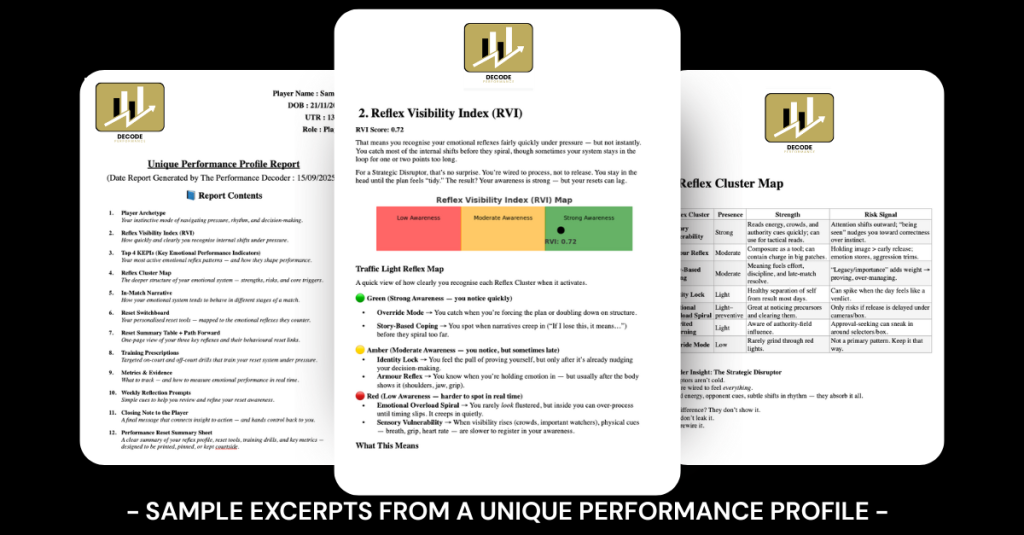
Every player has emotional reflexes. The difference comes when you learn to read them.
- - - - - - - - Three Books - One System - - - - - - - -


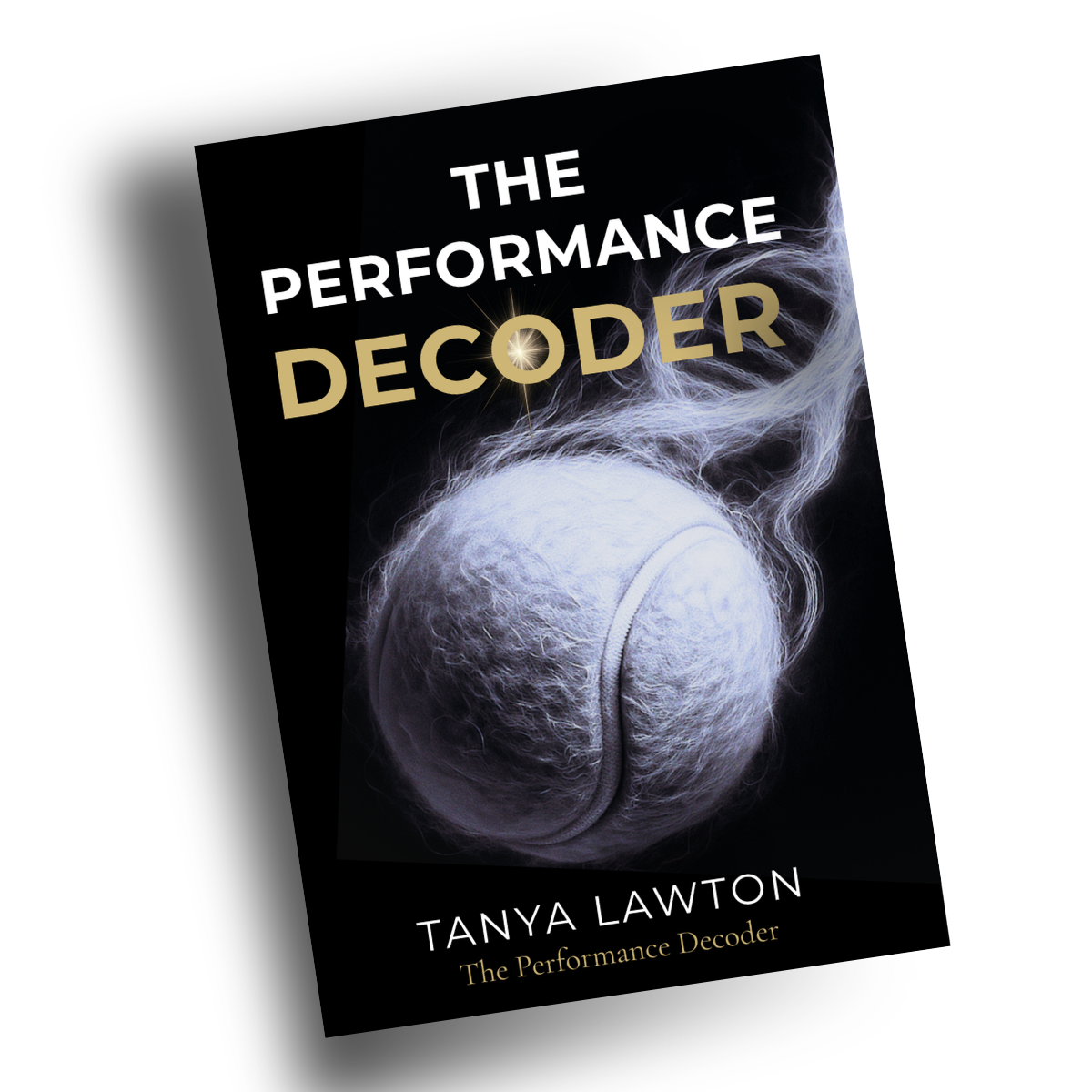
The Performance Decoder system is supported by three published works that explore different layers of emotional performance from awareness, to protection, to integration.
You don’t need to read them to take the quiz.
They exist for those who want to understand the work more deeply.
Testimonials
Some feedback
I am even more excited to play competitions in 2026, as in recent months I have been learning through my friend Tanya Lawton (The Performance Decoder). I have known Tanya since 2008 and was excited when she decided to publish her own books. Since first reading The Inner Game of Tennis in 1998, I have read and studied a plethora of content on mind skills from lots of different genres. Tanya’s approach stands out for me for firstly being tennis specific, and secondly being person specific. I found Tanya’s first two books (The Performance Decoder & Sixth Sense: Emotion) essential reading to understanding her overall approach and the key ingredient of developing a deeper understanding of emotion. I then did Tanya’s quiz and her report gave me amazing insights into my strengths and weaknesses and specific activities I could do to get the best out of myself. The clincher for me has been reading Tanya’s third book The Armour Paradox, where I now feel I have a fuller clarity in how I can improve as a player and a coach. The key learning for me is finding ways to help players to be able ‘express’ themselves rather than ‘protect’ themselves and how difficult that can be. I realise how much of my competitive tennis life I have been playing in ‘protection mode’ (fight, flight or freeze). I am watching professional tennis through a different lens now. I recently rewatched the 2025 Wimbledon Ladies Singles final and Amanda Anisomova’s post match press conference, where she describes ‘never being able to shake off her nerves’ (she lost 6-0 6-0).
Duncan Prior – tennis Coach – SW Australia
I believe this quiz is highly effective and can genuinely help players reflect on and better understand their emotions. It provides insight into what might be impacting their performance the most.
US College Player
Taking the quiz made me realise and learn things about myself and think about why I act the way I do. After receiving the report, I felt relieved that my thoughts can be put into words on paper and that I don’t struggle to communicate all my thoughts and feelings.
ITF Junior / Top 10 National Ranking
I especially appreciated the questions that prompted thoughts I hadn’t considered before, many of them are now actively on my mind moving forward.
US College Player
It’s like you stepped into my brain and gave me words for feelings I never could explain !
ITF Junior
If you’re looking for a starting point, the quiz is designed to give you a clear first layer of insight.
If you’re simply here to understand the philosophy behind the work, you’re in the right place.
Need more info . . .
If you would like anymore information or would just like a friendly chat about yor player. Please do not hesitate to contact me here.
Happy to be in association with . . .