When Presence Isn’t Passive – It’s the Highest Form of Precision
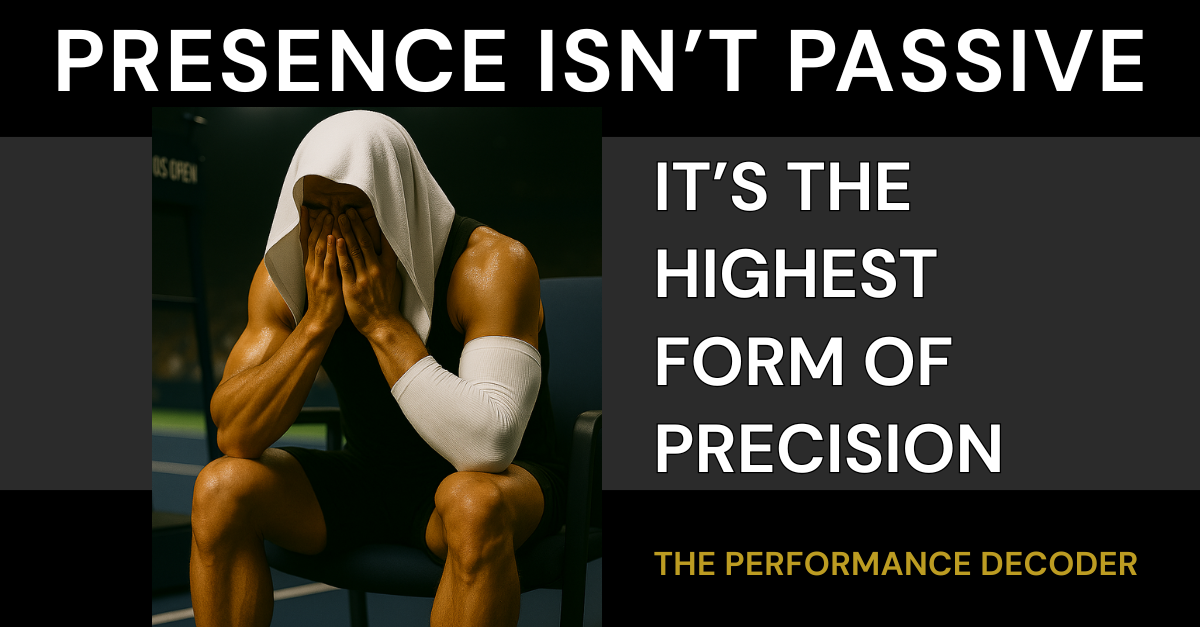
Rehab looks like a break in momentum — but it’s often the most powerful moment in an athlete’s evolution. When you can’t compete, you finally get to listen. To your body. To your mind. To the reflexes that once ran your game without you even realising.
I’m watching that unfold right now with a player in the middle of her rehab journey. Five months ago, she was restless — fighting frustration, anxious to return, and afraid that time away meant progress lost. But as the weeks slowed everything down, something remarkable began to surface. Without the noise of competition, results, and external expectation, we started exploring the reflexes that used to run her — the control patterns, the protective habits, the emotional speed that once masked what was really happening underneath.
What began as a physical rebuild has become something far deeper — an emotional recalibration. Each session now feels quieter, sharper, more connected. She’s learning to move from awareness rather than urgency — and that shift has changed everything. The power is still there, the intensity is still there, but it’s cleaner. More precise. More present.
But stillness doesn’t automatically create clarity — it simply removes the noise. That’s what makes this window so powerful: the pace slows, the performance mask lifts, and the patterns underneath become reachable. For most athletes, this space passes unnoticed. For those who know how to use it — it becomes emotional rehab: a chance to explore the deeper reflexes that shape instinct, confidence, and connection long before a ball is struck.
Rehab is not a period of loss of what you’ve built — it’s an extraordinary opportunity to reveal and integrate an evolved version of what you can become. The capacity to trust instinct, to move without interference, to let everything you’ve trained flow through freely — that’s what re-emerges when protection gives way to presence. What blocks it isn’t lack of skill — it’s the protective reflexes that step in when the stakes rise: control, doubt, overthinking, and the instinct to armour up.
The Gift Inside the Break
Performance breakdowns aren’t evidence of weakness — they’re exposure points for what’s ready to evolve. Rehab slows everything just enough for you to finally notice what’s been driving your game. And that pause — uncomfortable as it feels — is a chance to rewire the system, not just the body.
This isn’t a moment of loss. It’s a moment of opportunity — to redefine, to expand, to become what the previous version of you never had the safety, control, connection, or self-worth to access.
Whether it’s Player V2.0, V3.0 or beyond, the player doesn’t chase the feeling of being “back.” They build something new — a version with less noise, less tension, and more freedom in every breath.
From Protection to Precision
Inside The Performance Decoder, we call this process the Reflex-to-Flow Conversion Grid — a framework for translating old control patterns into embodied flow cues. It’s the art of transforming over-control into rhythm, tension into trust, and fear of exposure into emotional coherence.
Because every reflex that once shut you down wasn’t malfunctioning — it was trying to protect something: your safety, your sense of control, your connection to others, or your self-worth.
Rehab is your chance to teach those instincts a better way — protection through expression, not suppression. When the mind learns the body can feel without falling apart, performance stops being survival and starts becoming precision without resistance.
Redefining Flow
The path forward isn’t about reclaiming who you were — it’s about discovering who you could be when you no longer need control to feel safe. When confidence isn’t forced, but felt. When emotion isn’t a liability, but data. When presence isn’t passive — it’s the highest form of precision.
So if you’re in a rebuild phase — physical, emotional, or both — remember: you’re not on pause; you’re in redesign. Every drill, every breath, every moment of doubt is an opening to learn a new rhythm.
Because this isn’t about getting back. It’s about moving forward — lighter, clearer, freer. That’s the real definition of next-level.
The body heals when it’s given time. The emotions heal when they’re given truth.
Maybe rehab was never just about one of them.
Emotion is data. Intelligence is what you do with it.